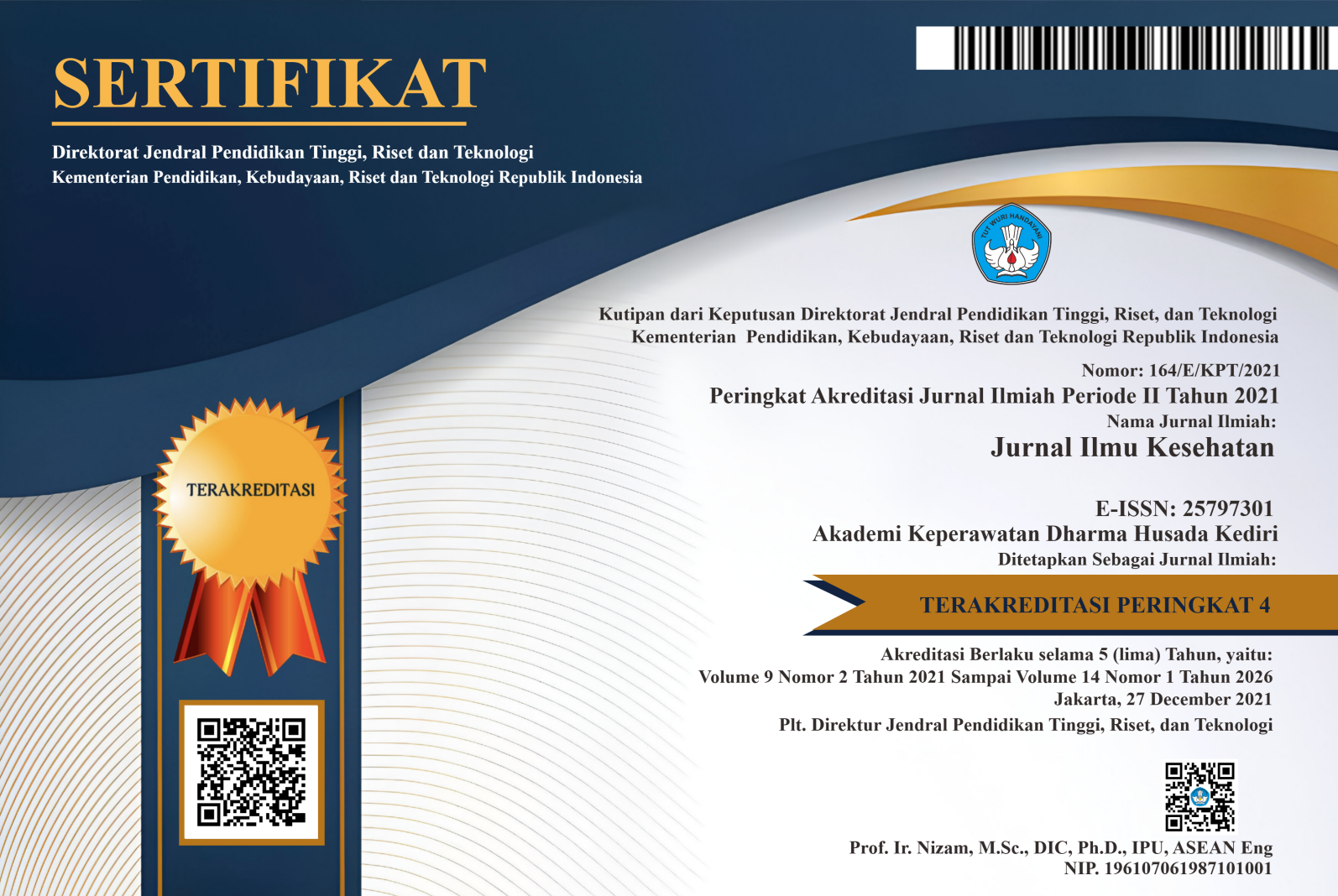
Accrediation Journal
Jurnal Ilmu Kesehatan (JIK) welcomes original scholarly manuscripts that contribute to the advancement of knowledge, evidence-based practice, and innovation in nursing, midwifery, public health, and nutrition. All submitted manuscripts must be original, scientifically sound, and relevant to the journal's focus and scope.
Authors are required to prepare their manuscripts in accordance with the following guidelines before submission.
Jurnal Ilmu Kesehatan accepts the following manuscript types:
Original Research Articles: Original empirical research employing quantitative, qualitative, or mixed-methods approaches, including experimental, observational, and intervention studies.
Literature Review Articles: Critical and systematic syntheses of existing scientific evidence, including systematic reviews, scoping reviews, integrative reviews, and meta-analyses.
Manuscripts must not have been previously published or be under consideration for publication elsewhere.
All manuscripts must be prepared using the official journal template and comply with the following formatting requirements:
File format: Microsoft Word (.doc or .docx).
Paper size: A4 (210 × 297 mm).
Font: Times New Roman, 12 pt.
Line spacing: Single (1.0).
Margins: Left 3 cm; top, right, and bottom 2.5 cm.
Language: Indonesian or English, with titles and abstracts provided in both languages.
Authors should use consistent formatting throughout the manuscript, including headings, tables, figures, citations, and references.
Manuscript Template: Download the Official JIK Manuscript Template
The title must accurately and concisely reflect the main content of the manuscript.
Provide the title in both Indonesian and English.
The Indonesian title should be centered and written in uppercase letters using 12-point Times New Roman.
The English title should be italicized and written in Title Case.
Avoid unnecessary abbreviations and overly lengthy titles.
All authors must be listed immediately below the manuscript title without academic degrees or professional titles.
Each author's institutional affiliation must be clearly identified. The corresponding author must provide a valid email address for editorial correspondence.
Authorship should accurately reflect substantial contributions to the research and preparation of the manuscript.
Manuscripts must include abstracts in both Indonesian and English.
Each abstract must not exceed 200 words and should provide a concise summary of the study, including:
Background: The research problem or rationale.
Objective: The primary aim of the study.
Methods: The study design, participants or data sources, and analytical approaches.
Results: The principal findings.
Conclusion: The main implications of the findings.
Each abstract must be followed by 3–5 keywords that accurately represent the manuscript's content.
The Introduction should establish the scientific background, identify the research problem, summarize relevant literature, explain the research gap, and clearly state the study objectives.
The section should be concise, preferably not exceeding two manuscript pages, while providing sufficient justification for the research.
The Methods section must provide sufficient information to enable readers to understand, evaluate, and, where appropriate, replicate the study.
For original research articles, this section should describe:
Study design and setting.
Study population, sampling procedures, and sample size.
Research variables and measurement instruments.
Data collection procedures.
Data analysis and statistical methods.
Ethical approval and informed consent, where applicable.
For literature review articles, authors should describe the review design, information sources, search strategy, eligibility criteria, study selection procedures, quality appraisal (where applicable), and evidence synthesis methods.
Authors are encouraged to follow relevant reporting guidelines, such as CONSORT, STROBE, PRISMA, or COREQ, according to the study design.
The Results section should present findings clearly, logically, and consistently with the study objectives.
Results may be presented using text, tables, and figures when appropriate. Tables and figures must be numbered consecutively, accompanied by informative titles or captions, and referenced in the manuscript.
Avoid unnecessary duplication of numerical information between the text and tables or figures.
The Discussion should interpret the principal findings in relation to the research objectives, relevant theories, and previously published studies.
Authors should explain the scientific and practical implications of their findings, identify agreements or discrepancies with existing evidence, and discuss study limitations.
The discussion must be supported by scientific evidence and should avoid unsupported claims or interpretations beyond the study findings.
The Conclusion should directly address the study objectives and summarize the most important findings without repeating detailed results.
Where appropriate, authors may include practical recommendations, implications for healthcare practice, or suggestions for future research.
Conclusions must be consistent with the study design, findings, and available evidence.
Jurnal Ilmu Kesehatan uses the Harvard author–date referencing system.
In-text citations must include the author's surname and year of publication, for example, (Smith, 2023) or Smith (2023).
All cited sources must be included in the reference list, and every reference listed must be cited in the manuscript.
References should be arranged alphabetically by the first author's surname.
Authors are encouraged to prioritize relevant, peer-reviewed scientific publications from the preceding ten years, while seminal references may be included when necessary.
Digital Object Identifiers (DOIs) should be provided whenever available.
Authors are encouraged to use reference management software, such as Mendeley, Zotero, or EndNote, to ensure citation accuracy and consistency.
All manuscripts must be submitted electronically through the official journal website:
Submission Portal: https://ejurnaladhkdr.com/index.php/jik
Authors must register for an account or log in using their existing credentials before submitting a manuscript.
The online submission process consists of five steps:
Step 1. Start
Select Make a New Submission, choose the appropriate journal section, review the submission requirements, and complete the necessary declarations.
Step 2. Upload Submission
Upload the manuscript file in Microsoft Word format and select the appropriate article component. Additional supplementary files may be uploaded when applicable.
Step 3. Enter Metadata
Provide accurate manuscript metadata, including the title, abstract, keywords, author names, institutional affiliations, and references, as requested by the submission system.
Step 4. Confirmation
Review the submission information and uploaded files carefully. Click Finish Submission to complete the process.
Step 5. Next Steps
Following successful submission, authors can monitor the manuscript's progress through the journal's online editorial system. Submission confirmation and subsequent editorial correspondence will be communicated through the journal system and email.
Before submitting a manuscript, authors must ensure that:
The manuscript aligns with the journal's focus and scope.
The manuscript follows the official JIK template and formatting requirements.
The title, abstract, and keywords are provided in Indonesian and English.
All authors and institutional affiliations are accurately identified.
Tables, figures, citations, and references are complete and properly formatted.
Ethical requirements and relevant declarations have been addressed.
The manuscript has not been published or submitted simultaneously to another journal.
Manuscripts that do not comply with these guidelines may be returned to the authors for technical revision before proceeding to editorial assessment or peer review.


